
- October 24, 2026
- Posted by: Aura Finance
- Category: Uncategorized
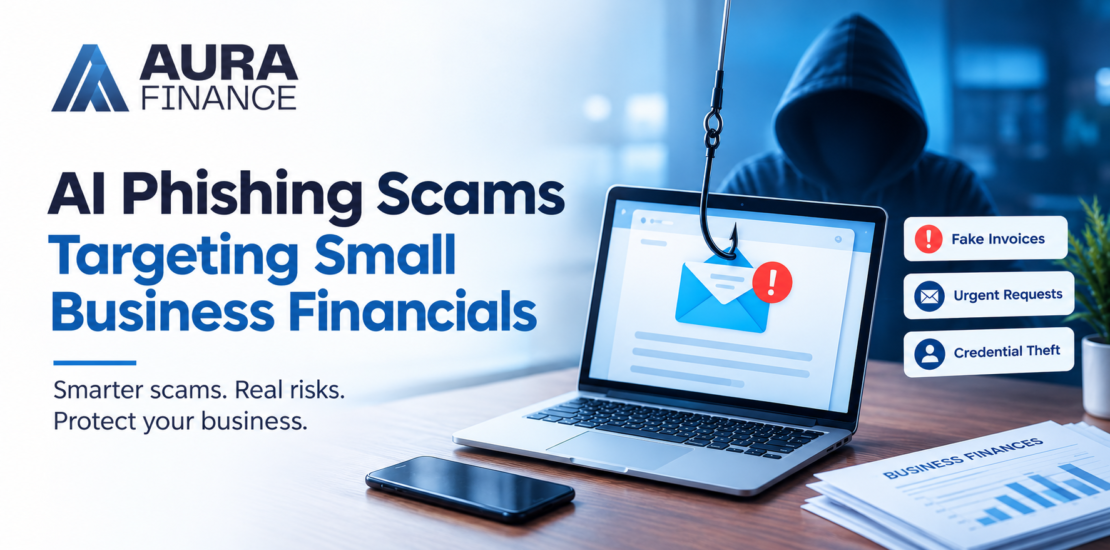
For years, small business owners could spot a phishing email a mile away. These emails had unmistakable misspellings, were sent from ridiculous domains and contained urgent, awkward requests for a wire transfer.
Those days are over.
Today, cybercriminals use advanced, specialized artificial intelligence and large language models to carry out very targeted and accurate financial fraud. In this context, it is critical for small-business owners to understand the risks involved.
These are not wholesale scams: the modern cybercriminals target specific companies and spend time and resources to penetrate their spam defenses, impersonate their suppliers, and drain their accounts.
The Anatomy of an AI-Augmented Financial Exploit
Whereas traditional phishing focused on quantity, AI phishing emphasizes quality, sometimes called AI Spear Phishing or Business Email Compromise (BEC). Tools that use generative AI can scrape your company’s LinkedIn, website, and your chamber of commerce directory to identify your network structure.
Here is how an AI phishing attack commonly unfolds against a small business:
1. Perfect Mimicry: The AI uses text pattern recognition to analyze the writing pattern of your primary supplier, external CPA, or even yourself (if your email was intercepted in a previous data breach). The AI creates a business email impersonating the writing pattern with nuances, such as specific terminology, punctuation, and paragraphs’ organization.
2. Contextual Invoicing: The AI constructs a scenario and inserts it into an invoice approval request, e.g., “As you are aware, we are switching to a new software system, and therefore our banking information has changed; kindly remit your usual quarterly payment to our new account.”
3. Flawless Execution: There are no spelling mistakes. Local phrasing is correct. It is sent on a busy day for your accounting department, such as, a Friday afternoon, or the last hectic week of the fiscal quarter.
Why Small Businesses are Targets
In the minds of cyber-criminals, big business is a lucrative target. That is why they invest much needed resources in a Security Operations Center and employee monitoring. On the other hand, small businesses have a decent amount of capital and daily transactions, but lack the infrastructure to protect it.
Conclusion
The increased use of AI in cybercrime software makes spam filters and other security measures ineffective. In small businesses, the focus should be on implementing strict controls and multiple protection layers to eliminate the risks posed by AI-enabled fraudsters. Red flags, including spelling mistakes and grammatical errors, should no longer be the center of the security model. The security strategy should revolve around email security and include mandatory secondary verification steps for financial requests. Checks and payments should be made through protected channels and double-confirmed by phone or in-person. Vendors’ information should also be verified through alternative communication channels. Small businesses must limit the publicity of the company’s executive structure on social media networks to prevent threat actors from identifying weak spots and inserting themselves into the business’s financial system. You should visit the best Tax accountant in Toronto. Employees should participate in ongoing training sessions about the latest social engineering methods and protect the financial details of the company. Constant audits of internal controls and practices in collaboration with cybersecurity experts can reveal the weak spots that AI fraudsters can use to infiltrate the system. These measures will help small business owners stay ahead of AI-enabled cybercrime and protect their profits from being siphoned away by malicious algorithms.
FAQs
Q1: What are the differences between traditional phishing schemes and AI phishing scams?
A1: Traditional phishing scams include email templates with grammatical errors and incorrect language to lure innocent users. On the other hand, AI scams utilize Large Language Models, such as GPT, to generate sophisticated phishing emails with no mistakes in grammar and language.
Q2: How do cybercriminals use AI to infiltrate large companies and steal money?
A2: Cybercriminals use AI algorithms to analyze the targets, specifically data available on the company’s website or social media. Moreover, advanced scams use AI to clone a familiar voice to call the target and persuade them to take action.
Q3: What is the best way to prevent an AI phishing scam from stealing company funds?
A3: The best 3 fraud prevention rules are never sending any money via email, double-checking all wire transfers, and never giving out bank details. Besides, it is essential to have a verification procedure, for example, a calling back via known phone numbers of administrators.
Q4: Can AI phishing emails be filtered as spam?
A4: AI phishing emails are challenging to detect and delete as spam because they look authentic and do not have any malware or links. Moreover, traditional spam filters do not protect against social engineering scams.
Q5: Why do small organizations become victims of phishing scams more frequently than big corporations?
A4: Aura Finance believes that there are several reasons why small organizations are targeted more by cybercriminals. First, small businesses typically have lower security precautions and less experienced security personnel. Finally, small organizations often have a flat organizational structure where employees are prone to complying with emails from executives.